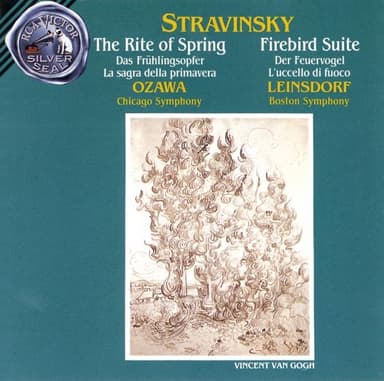
The Rite of Spring: Introduction
Igor Stravinsky
The opening minutes of Stravinsky's Rite of Spring represent one of the most consequential sonic ruptures in Western music — the moment the 20th century announced itself through sheer rhythmic violence and harmonic confrontation. The introduction begins, deceptively, with an unaccompanied bassoon playing in its highest register, a sound so strange and strained it was initially mistaken for a different instrument entirely. The melody is modal, folk-derived, deliberately primitive in character — Stravinsky reached toward ancient Lithuanian folk song to simulate something pre-civilized, pre-tonal. Then other woodwinds enter, overlapping in polytonality, the harmonic language colliding rather than resolving, building a dense, anxious texture that suggests something ancient stirring beneath cold soil. The rhythms are unpredictable, accents landing in unexpected places, the orchestra breathing in uneven gasps. The infamous 1913 Paris premiere ended in riots — audiences understood instinctively that this music was not offering beauty in any previously understood sense but instead a kind of primordial pressure, life asserting itself through rupture rather than flowering. The cultural stakes were total: this piece divided music history into before and after. You'd approach it the way you'd approach a storm — not for comfort, but to feel something vast moving through you that you cannot control.
slow
1910s
dense, dissonant, raw
Russian, Lithuanian folk tradition
Classical, Modernist. Ballet introduction.
anxious, primordial. Opens in eerie, strained solitude and progressively layers dissonant woodwind voices until a dense, anxious polytonality suggests something ancient and violent stirring beneath the surface..
energy 5. slow. danceability 2. valence 2.
vocals: no vocals; solo bassoon in extreme high register — strained, strange, quasi-human.
production: woodwind-heavy, polytonal overlapping, irregular rhythmic accents, folk-derived modal melody, modernist orchestration.
texture: dense, dissonant, raw. acousticness 7.
era: 1910s. Russian, Lithuanian folk tradition.
Bracing before a storm — not for comfort, but to feel something vast and uncontrollable moving through you.