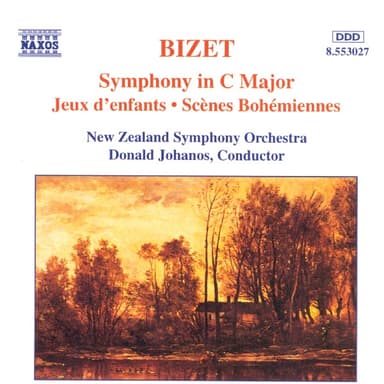
Symphony in C major: I. Allegro vivo
Georges Bizet
The first movement opens with the kind of confident clarity that only youth produces — Bizet composed this symphony at seventeen, and you can hear both the mastery and the unself-consciousness of someone working before he learned to be careful. The strings launch into a theme that is light, dancing, and irresistibly forward-moving, shaped by Haydn and early Mozart but with a melodic freshness that belongs entirely to Bizet's own sensibility. The texture remains transparent throughout, chamber-like even in full orchestral passages, each instrument line audible and distinct. What strikes you is the joy in it — uncomplicated, kinetic, without irony or darkness. The development section introduces small harmonic surprises before the recapitulation returns with the inevitability of a ball bouncing back. It belongs to the pre-Romantic tradition in its formal discipline while already hinting at the warmth that would characterize Bizet's mature style. This is music for bright mornings: the kind of piece that functions as an argument for optimism, for the pleasure of pure musical motion, for the idea that elegance need not carry weight.
fast
1850s
bright, transparent, airy
French classical, influenced by Haydn and early Mozart
Classical. Classical Symphony.
euphoric, playful. Opens with bright, dancing confidence, introduces small harmonic surprises in development, then returns with the easy inevitability of uncomplicated joy..
energy 7. fast. danceability 6. valence 9.
vocals: instrumental, no vocals.
production: transparent strings, light woodwinds, chamber-like even at full orchestration.
texture: bright, transparent, airy. acousticness 8.
era: 1850s. French classical, influenced by Haydn and early Mozart.
Bright weekend mornings when you want music that makes the day feel full of possibility and forward motion.