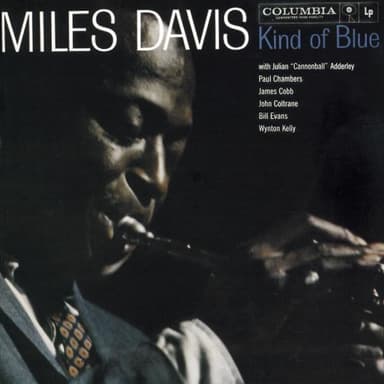
Kind of Blue
Miles Davis
The bass arrives first — a low, unhurried walking figure that feels less like an introduction and more like a door being quietly opened. Then a piano chord, voiced in a way that sounds simultaneously ancient and weightless, and finally the trumpet enters without announcement, cool and deliberate as fog moving across still water. "So What" operates almost entirely on restraint, built on two modal scales that give the soloists vast open sky rather than chord changes to navigate around. Miles Davis's trumpet tone here is famously detached — he doesn't reach for notes, he places them, each phrase landing with the inevitability of something that was always supposed to be there. John Coltrane's tenor solo churns and searches beneath the surface before Paul Chambers's bass and Jimmy Cobb's brushed snare bring everything back to equilibrium. The piece belongs to 1959, to the exhausted elegance of late-night Manhattan, to a cultural moment when jazz was reinventing its own grammar. It has no lyrics because none are needed — the emotional content is entirely architectural. You reach for this on a late commute home when the city has finally gone quiet, when you want music that doesn't ask anything of you except your full, unhurried attention.
slow
1950s
spacious, cool, deliberate
American jazz, 1959 late-night Manhattan, bebop-to-modal transition
Jazz, Modal Jazz. Cool Jazz.
contemplative, serene. Opens with restrained cool and sustains a detached, searching quality through saxophone tension before returning to equilibrium.
energy 3. slow. danceability 2. valence 6.
vocals: instrumental — no vocals.
production: upright bass walking figure, brushed snare, sparse piano, muted trumpet, tenor saxophone.
texture: spacious, cool, deliberate. acousticness 9.
era: 1950s. American jazz, 1959 late-night Manhattan, bebop-to-modal transition.
Late commute home when the city has finally gone quiet and you want music that doesn't ask anything of you except your full, unhurried attention