All Blues
Miles Davis
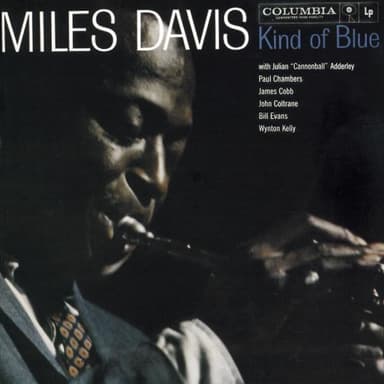
There is no track by this name, but the phrase "Kind of Blue" describes a feeling more than a title — the particular quality that saturates every recording session Miles Davis made in the spring of 1959. It is the blue of pre-dawn light through a window, the blue of something unresolved but not unhappy, a color without sharp edges. The sound is famously sparse: modal scales replacing chord changes, rhythmic tension replaced by a kind of floating time-feel, and a band — Davis, Coltrane, Cannonball Adderley, Bill Evans, Wynton Kelly, Paul Chambers, Jimmy Cobb — that understood silence as a musical element equal to any note. What makes the "kind of blue" sound distinctive is its refusal of climax: nothing here strains or erupts. The emotional texture is neither melancholy nor contentment but something more philosophically honest — the acknowledgment that some feelings don't resolve, they simply exist. Culturally, this aesthetic marked the end of bebop's velocity and complexity as the dominant jazz language and opened a modal, meditative chapter whose influence would spread far beyond jazz. You listen when you need music that is not asking you to feel a specific thing, only to be present.
slow
1950s
sparse, floating, weightless
American jazz, 1959 New York, twilight of bebop era
Jazz, Modal Jazz. Cool Jazz.
meditative, contemplative. Resists climax throughout, sustaining a philosophical equanimity between melancholy and contentment that never resolves.
energy 2. slow. danceability 1. valence 5.
vocals: instrumental — no vocals.
production: sparse ensemble, modal scales, silence as structural element, piano, upright bass, brushed drums.
texture: sparse, floating, weightless. acousticness 9.
era: 1950s. American jazz, 1959 New York, twilight of bebop era.
When you need music that is not asking you to feel a specific thing, only to be present