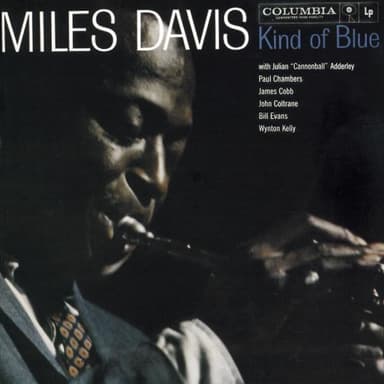
Blue in Green
Miles Davis
Wynton Kelly sits at the piano for this one instead of Bill Evans, and the difference is immediately felt — where Evans brings contemplative weight, Kelly brings a lighter, more swinging touch, and "Freddie Freeloader" breathes easier for it. This is the most accessible piece on Kind of Blue, a straightforward twelve-bar blues played at a relaxed mid-tempo, the band in obvious, easy communication. Miles's trumpet is open-toned here, unwalled by a mute, his lines generous and conversational rather than searching. The piece is named for a real person — a figure who drifted through the jazz world's orbit — and carries something of that character: unhurried, present, comfortable taking up space without apology. Coltrane and Adderley each take extended solos, and the contrast between their approaches — Coltrane's muscular precision, Adderley's blues-drenched warmth — reveals how much tonal personality even one scale can contain. Culturally, this is jazz at its most democratic, the form before it became academic, music that still had one foot in the bar and the dance floor. You reach for it in the middle of an afternoon that has no particular urgency, when the sun is doing something pleasant and you want music that confirms it.
medium
1950s
warm, swinging, open
American jazz blues vernacular, pre-academic jazz tradition
Jazz, Blues. Swing Jazz.
relaxed, playful. Maintains easygoing warmth and conversational openness from start to finish, democratic and entirely undemanding.
energy 4. medium. danceability 5. valence 8.
vocals: instrumental — no vocals.
production: open-toned trumpet, walking bass, swinging piano, alto saxophone, tenor saxophone.
texture: warm, swinging, open. acousticness 9.
era: 1950s. American jazz blues vernacular, pre-academic jazz tradition.
Middle of an afternoon with no particular urgency, when the sun is doing something pleasant and you want music that confirms it