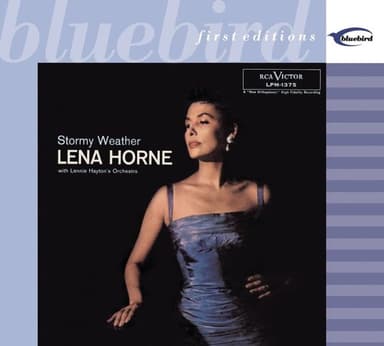
Stormy Weather
Lena Horne
The opening is almost orchestral in its gravity — strings entering low and wide, establishing a weather system before Horne opens her mouth. And when she does, she doesn't sing so much as inhabit a climate. Her voice is an instrument of extraordinary controlled power: she can whisper and fill a room, she can strike a phrase like a match. "Stormy Weather" — Harold Arlen's masterpiece of atmospheric depression — became her signature not because she simply sang it beautifully but because she found something inside it that felt like lived testimony. The arrangement is deliberately heavy, the tempo dragging just enough to feel like wading through humidity. There's a loneliness in the production itself, space left open around her voice that amplifies the isolation the lyric describes. Horne delivers the melody straight, refusing ornamentation where a lesser artist would reach for it, trusting the raw architecture of the song and her own tonal authority to carry the weight. By the time she reaches the final passages, there's a sense of someone not performing sadness but processing it in real time, standing under the rain and refusing to move. This is the sound of blues filtered through absolute compositional elegance. You put this on when you need to honor a grief rather than escape it.
slow
1940s
heavy, humid, spacious
American jazz and blues, Harlem Renaissance
Jazz, Blues. Blues Ballad / Jazz Standard.
melancholic, sorrowful. Begins in weighted, atmospheric grief and intensifies steadily, arriving at raw unresolved longing rather than any form of release..
energy 3. slow. danceability 2. valence 2.
vocals: powerful contralto, controlled authority, whisper-to-room-filling, raw, testimony-like.
production: orchestral strings, low and wide, deliberate space around the voice, atmospheric.
texture: heavy, humid, spacious. acousticness 5.
era: 1940s. American jazz and blues, Harlem Renaissance.
When grief needs to be honored rather than escaped — sitting quietly with the full weight of something real.