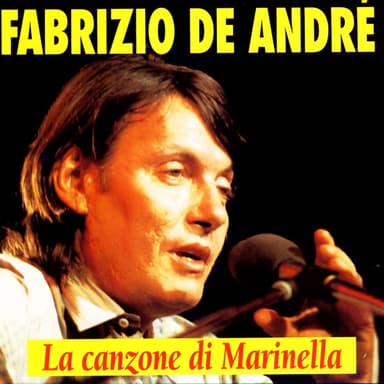
Canzone di Marinella
Fabrizio De André
There is something almost unbearably beautiful about this song's melody — it spirals upward and folds back on itself with the logic of a dream, and De André's vocal performance may be the most nakedly emotional of his entire career. He sings about a young woman drowned in a river with a tenderness so complete it approaches the sacred. The production is minimal but exquisitely weighted: guitar, the sense of water and winter light, a voice that seems to hold the entire story of a life briefly lived. The emotional landscape is grief without self-pity, love without possession, elegy without sentimentality — the song mourns a woman who was failed by the world while insisting on the incandescent value of her having existed at all. Lyrically it transforms a stark social reality — a young woman abandoned and destroyed by poverty and male violence — into something that flickers like candlelight, fragile and insistent. It comes from the same Italian folk revival tradition as his other early work but feels set apart, as if De André had found a register here that he would only occasionally revisit. The cultural resonance is enormous in Italy, where it is considered one of the defining songs of the cantautore movement. You reach for this when language has run out for something you need to feel anyway — grief, love, the particular ache of beauty existing alongside cruelty, the need to honor a life the world overlooked.
slow
1960s
ethereal, delicate, sparse
Italian folk revival, cantautore movement
Folk, Italian Folk. Elegy.
elegiac, tender. Spirals through grief without self-pity and love without possession, arriving at an insistence on the value of a brief life that feels almost sacred..
energy 2. slow. danceability 1. valence 3.
vocals: nakedly emotional male baritone, tender, almost sacred, vulnerable.
production: minimal acoustic guitar, sparse, exquisitely weighted, no ornamentation.
texture: ethereal, delicate, sparse. acousticness 9.
era: 1960s. Italian folk revival, cantautore movement.
When language has run out for something you need to feel anyway — grief, love, the ache of beauty existing alongside cruelty.