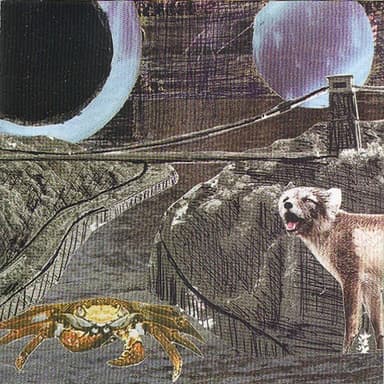
Come See the Duck
Deerhoof
Deerhoof occupies a particular and strange corner of American experimental music — childlike in surface texture, fundamentally unsettling underneath — and this track demonstrates that duality with characteristic precision. Satomi Matsuzaki's vocals arrive in a high, clean register that carries the cadences of a nursery rhyme while the guitars beneath her turn unexpectedly angular, Greg Saunier's drumming punctuating phrases in ways that undercut any expected resolution. The production is dry and close, each instrument occupying a distinct space without warmth padding the gaps between them. The harmonic choices are genuinely peculiar — chords that sit slightly wrong relative to where you expect them to land — and this wrongness is not accidental but carefully engineered to create a low-level unease that the cheerful vocal delivery refuses to acknowledge. Lyrically the song operates on the plane of the surreal and benignly nonsensical, which suits the band's broader aesthetic of language-as-texture rather than language-as-meaning. Deerhoof emerged from the Bay Area underground of the late 1990s carrying influences that range from Japanese noise to avant-garde composition to pure pop immediacy, and this track puts all those affinities in conversation simultaneously. It is music for a specific attentive listening — it rewards close attention and punishes background play, continually doing something unexpected in the corner of the sound that you'd miss otherwise.
medium
2000s
dry, angular, strange
Bay Area experimental underground, Japanese noise influence
Indie Rock, Experimental. avant-garde art-pop.
playful, unsettling. Maintains a cheerful nursery-rhyme surface throughout while carefully engineered harmonic wrongness creates persistent low-level unease the vocals never acknowledge..
energy 6. medium. danceability 5. valence 5.
vocals: high clean female, nursery-rhyme cadence, innocent tone masking structural strangeness.
production: dry close recording, no warmth between elements, distinct instrument separation, angular guitar punctuation.
texture: dry, angular, strange. acousticness 4.
era: 2000s. Bay Area experimental underground, Japanese noise influence.
Attentive solo listening session where close attention is rewarded — falls apart as background music, reveals itself under headphones.