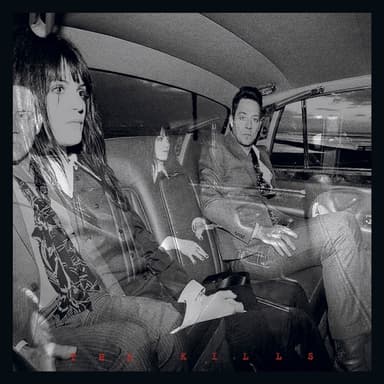
DNA
The Kills
There is a kind of electricity that doesn't warm you — it burns. "DNA" runs on that current entirely, built from a drum machine locked into a repetitive pulse that feels less like rhythm and more like a heartbeat being monitored in a cold room. Jamie Hince layers guitar lines that scrape rather than sing, producing a texture closer to rust than melody. Alison Mosshart's voice enters with the casual menace of someone who already knows how this ends — her delivery is low, almost spoken at first, before it curls into something predatory. The song is about the irreducible biological pull between two people, the idea that attraction is not chosen but written into you at a cellular level. There is no romance here in the conventional sense; instead, there is something closer to fate rendered as friction. The production stays deliberately minimal, because adding more would soften what needs to stay hard. This is music for the moment after midnight when the conversation between two people has narrowed to a single question neither is willing to ask out loud. It belongs to a lineage of lo-fi garage rock that prizes rawness over polish, the kind of song that sounds like it was recorded in the same room where the events it describes took place — walls close, air thick, no escape route built in.
medium
2000s
raw, cold, electric
Anglo-American lo-fi garage rock
Garage Rock, Indie Rock. Lo-Fi Garage.
predatory, intense. Opens with cold, near-spoken menace and curls gradually into something predatory and inevitable, framing attraction as fate rendered as friction..
energy 7. medium. danceability 5. valence 4.
vocals: low female, almost spoken, casual menace curling predatory.
production: cold drum machine pulse, scraping guitar layers, deliberately minimal, lo-fi.
texture: raw, cold, electric. acousticness 2.
era: 2000s. Anglo-American lo-fi garage rock.
After midnight when a conversation between two people has narrowed to a single question neither is willing to ask out loud.