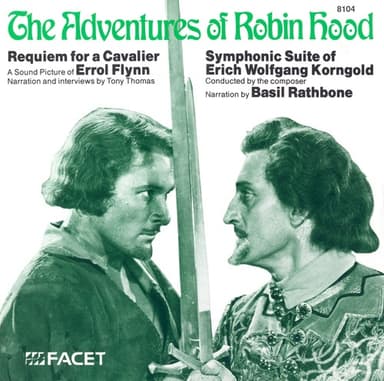
The Adventures of Robin Hood (The Adventures of Robin Hood)
Erich Wolfgang Korngold
A full orchestra erupts with the kind of swashbuckling confidence that makes the air itself feel like an adventure waiting to happen. Korngold's score for Robin Hood moves with the kinetic energy of a man swinging through forest canopies — brass fanfares that announce heroism before it even arrives, strings that chase each other like arrows in flight. The tempo shifts constantly, never settling, mirroring the mercurial spirit of a man who lives by his wits. There's genuine warmth woven through the heroics: woodwind passages that feel like dappled sunlight through Sherwood Forest, moments of tenderness that remind you this is ultimately a story about justice and love rather than combat. The music is unabashedly romantic in the 19th-century European tradition, unafraid of grandeur, treating every scene as if it matters enormously. You feel Korngold's European classical training in every chord progression — this is Viennese late-Romanticism transplanted into Hollywood, and the transplant took magnificently. Reach for this when you want to feel the world is larger than it is, when ordinary life needs the sensation of something at stake. It's the sound of believing, completely and without irony, in heroes.
fast
1930s
bright, grand, kinetic
American Hollywood, Viennese Romantic tradition
Classical, Film Score. Swashbuckling Adventure Orchestral.
euphoric, playful. Charges forward with heroic confidence from the first measure, weaving in warm woodwind tenderness before returning to triumphant brass fanfare..
energy 9. fast. danceability 5. valence 9.
vocals: instrumental only.
production: brass fanfares, racing strings, full orchestra, Viennese late-Romantic orchestration.
texture: bright, grand, kinetic. acousticness 8.
era: 1930s. American Hollywood, Viennese Romantic tradition.
When ordinary life needs the sensation of something at stake — the sound of believing completely and without irony in heroes.