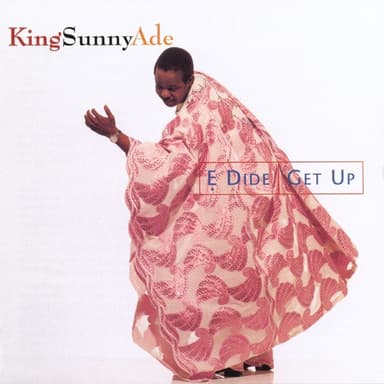
E Dide
King Sunny Ade
There is a ceremonial quality to the opening that signals this song operates on a different register than purely entertainment-oriented music. The percussion enters first, establishing a groove that feels ancient and specific — rooted in traditions where rhythm has spiritual function, where the drums are not background but foreground, not decoration but declaration. As the arrangement fills in with multiple guitar voices and the characteristic jùjú bass patterns, the overall texture becomes dense and luminous simultaneously, somehow both intricate and spacious. Ade's voice on this track carries particular authority — the Yoruba language gives his phrasing a specific rhythmic character that the melody is built around rather than imposed upon, and the result is singing that feels inseparable from the language it inhabits. The lyrical core is a call to rise, to stand, to be present — an exhortation rather than a narrative, functional music in the deepest sense, designed to activate rather than observe. The multiple vocal responses that weave around Ade's lead create a texture of community, the sense that this song belongs to more than one person and more than one moment. Culturally, this is a record that situates itself at the intersection of Yoruba oral tradition and electric music, and it wears that position without strain. You reach for it when you need music that asks something of you rather than simply washing over you — something that requires your full presence in exchange for its full reward.
medium
1980s
dense, luminous, intricate
Nigerian, Yoruba oral tradition meeting electric music
Jùjú, African. Nigerian Jùjú.
ceremonial, exhortatory. Opens with spiritual gravity and builds through communal vocal layering into a full-throated call to rise and be present..
energy 6. medium. danceability 6. valence 7.
vocals: authoritative male, exhortatory, Yoruba-inflected rhythm, communal call-and-response.
production: front-loaded percussion, multiple interlocking guitars, jùjú bass patterns, talking drum.
texture: dense, luminous, intricate. acousticness 4.
era: 1980s. Nigerian, Yoruba oral tradition meeting electric music.
When you need music that demands your full presence in exchange for its full reward — not background listening.