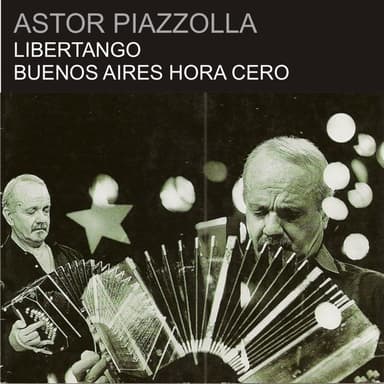
Buenos Aires Hora Cero
Astor Piazzolla
Astor Piazzolla's "Buenos Aires Hora Cero" — Buenos Aires Hour Zero — stakes out its territory with the title alone: this is the city at its most liminal, the precise moment between night and morning when ordinary time suspends. Piazzolla's nuevo tango aesthetic breaks decisively from golden age convention: the harmonic language is jazz-inflected, the rhythms deliberately unsettled, the emotional register more existential than romantic. The bandoneon work is technically extraordinary — Piazzolla was arguably the instrument's greatest virtuoso — and in "Hora Cero" it carries a quality of urban tension, the city's nervous system exposed at its most vulnerable hour. The arrangement features the kind of counterpoint and rhythmic complexity that made Piazzolla's music controversial among traditional tango purists: this is not music designed for dancing in the conventional sense, but for listening with the full concentration one brings to contemporary classical or jazz. The city evoked is both specific (Buenos Aires in the 1960s-70s, under political pressure, in cultural ferment) and universal (any great city at that suspended hour of night's end). For listeners approaching tango through Piazzolla, this piece is essential — it shows the master at his most compositionally ambitious, creating a musical portrait of urban consciousness that transcends genre.
medium
1960s
edgy, unsettled, nocturnal
Argentina
Tango, Contemporary Classical. Nuevo Tango.
tense, existential. Establishes urban tension immediately and sustains it through layered complexity without resolution, ending in suspended unease..
energy 7. medium. danceability 3. valence 3.
production: jazz-inflected bandoneon, complex ensemble, modernist.
texture: edgy, unsettled, nocturnal. acousticness 5.
era: 1960s. Argentina.
Listen with full concentration late at night as you would to contemporary chamber music or jazz.