Sârba
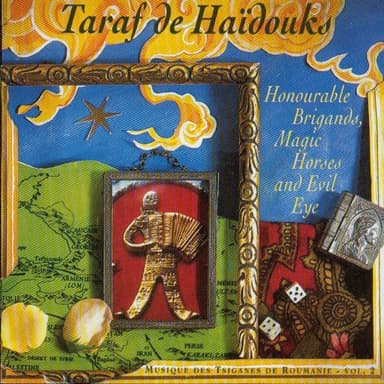
Taraf de Haïdouks
The sârba is the defining Romanian dance form — fast, in 2/4 meter, built for the specific joy of group movement in a closed circle — and Taraf de Haïdouks plays it with the casualness of musicians who have performed this form thousands of times. The Taraf's "Sârba" has the looseness of music that serves a social function, the ensemble prioritizing collective lock over individual display, though individual virtuosity is never absent for long. The lead violin traces the melody with characteristic Romanian ornamental vocabulary — mordents, slides, the particular bowing pressure that creates the style's rhythmic urgency — while the rhythm instruments create a groove that makes the dance feel inevitable rather than forced. Culturally, the sârba represents Romania's contribution to the broader Balkan dance tradition, its circle-dance format connecting it to regional forms from Serbia to Greece while maintaining distinctive melodic and rhythmic character. The Taraf plays it as it was meant to be played: for bodies, not ears alone.
fast
1990s
loose, warm, rhythmically driven
Romania
World Music. Romanian Folk / Sârba Dance.
joyful, communal. Maintains a steady, unforced joy from start to finish — the emotion of a form mastered so well it becomes effortless..
energy 7. fast. danceability 9. valence 9.
vocals: instrumental — no vocals.
production: lead violin, rhythm strings, acoustic bass, traditional ensemble.
texture: loose, warm, rhythmically driven. acousticness 9.
era: 1990s. Romania.
Background music for a festive dinner or as accompaniment to a circle dance at a cultural gathering.