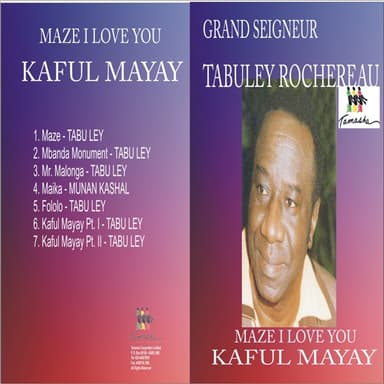
Kaful Mayay
Tabu Ley Rochereau
"Kaful Mayay" demonstrates Tabu Ley Rochereau's range within the rumba idiom — a track that moves between moods with the fluency of someone who has fully internalized the form's possibilities. The guitar work establishes a melodic character early, the lead instrument carrying thematic material that Tabu Ley's voice will later take up and transform. Afrisa International operates here as a responsive collective: musicians listening acutely to each other, the ensemble shifting texture and density in response to what the lead voice needs in each section. Tabu Ley sings with an emotional commitment that elevates the performance beyond mere technical accomplishment — he inhabits the material rather than demonstrating it. The production's sense of time is characteristically generous: these songs were made for people who had time to enter them fully, not for an attention economy that demands immediate gratification. There's a quality of trust in the listener built into the long-form Congolese rumba structure, a belief that given enough musical richness and time, the audience will follow wherever the music leads. "Kaful Mayay" rewards precisely that kind of willing attention, revealing additional layers of melodic and rhythmic information with each listen.
medium
1970s
layered, generous, fluid
Democratic Republic of Congo
World, Congolese Rumba. Soukous / Romantic rumba.
contemplative, romantic. Moves between moods with fluid intelligence, the ensemble shifting texture responsively as the vocal leads through emotional terrain..
energy 5. medium. danceability 7. valence 6.
vocals: committed, inhabiting, expressive, range-traversing, emotionally present.
production: responsive ensemble, lead guitar thematic material, Afrisa International collective.
texture: layered, generous, fluid. acousticness 4.
era: 1970s. Democratic Republic of Congo.
Unhurried listening session where you have time to follow the music fully without the pressure of an attention economy.