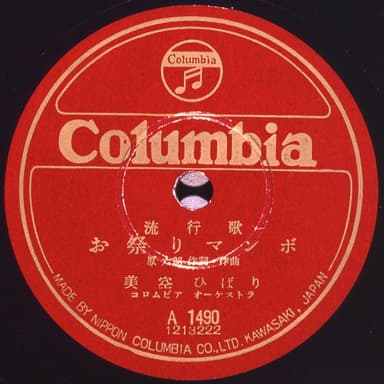
お祭りマンボ (Omatsuri Mambo)
Hibari Misora
"お祭りマンボ" (Festival Mambo), recorded in 1952 when Hibari Misora was just fifteen, is a gleeful culture-collision — Japanese festival spirit squeezed into the Latin mambo rhythm that was sweeping the world in the early 1950s. The result is irrepressibly joyful and slightly chaotic, the rhythm section driving forward while Misora's voice — already remarkably mature and commanding for her age — navigates between Japanese melodic phrases and the mambo's syncopated demands. The brass arrangement is jubilant and slightly anarchic, matching the festival imagery in the lyrics: crowds, noise, summer heat, the particular abandon of traditional celebration. What makes this historically remarkable is how naturally Misora inhabits the mambo groove without abandoning her Japanese vocal identity — she sounds neither like a Western performer nor like someone simply applying a foreign style to domestic material, but like someone who has genuinely made the crossover her own. Culturally it represents Japan's postwar openness to global popular culture, the same spirit that would later produce City Pop and J-Pop's many genre experiments. As listening experience it is pure fun — one of those recordings that defeats self-consciousness and demands physical response.
fast
1950s
bright, chaotic, irresistible
Japan
J-Pop, Latin. mambo-Japanese crossover.
joyful, festive. Pure uncontained festivity from beginning to end with no emotional complexity or resolution needed..
energy 9. fast. danceability 9. valence 10.
vocals: commanding, rhythmically agile, playful, precociously mature, festive.
production: jubilant brass, mambo rhythm section, syncopated, gleefully anarchic.
texture: bright, chaotic, irresistible. acousticness 2.
era: 1950s. Japan.
Summer festivals, celebratory gatherings, or exploring postwar Japan's joyful absorption of global popular culture.