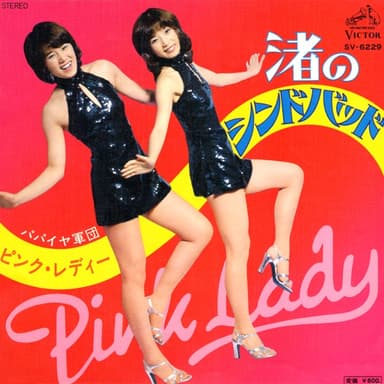
渚のシンドバッド (Nagisa no Sindbad)
Pink Lady
From the first crashing downbeat, this song plants itself squarely in the disco era with the conviction of a group that understood spectacle as a form of sincerity. Pink Lady arrived as a duo engineered for maximum impact — matching outfits, synchronized choreography memorized by children across Japan, hooks sharp enough to lodge in the brain for decades. The arrangement is unapologetically dense: slapped bass, wah-wah guitar, orchestral flourishes that arrive like exclamation points, a production style that borrows from American funk and Eurodisco while maintaining the idol-pop architecture of repeated refrains and responsorial vocal runs. The lyrics invoke the legend of Sinbad through a beachside romantic adventure, the sea functioning as both literal setting and metaphor for desire's vastness. What makes Pink Lady compelling beyond the obvious craftsmanship of the songwriting team is Mie and Kei's performance precision — their voices blend into a single confident entity, playful and a little dangerous, entirely in command of the room. The song exists to be performed in front of a crowd, and even on record the energy of that performance fills every measure.
fast
1970s
dense, bright, kinetic
Japan
J-Pop, Disco. Idol Disco.
exuberant, playful. Arrives at full intensity and sustains it — a spectacle of confident, collective energy with no emotional descent..
energy 9. fast. danceability 9. valence 8.
vocals: precise, blended duo, playful, confident, performance-commanding.
production: slapped bass, wah-wah guitar, orchestral flourishes, Eurodisco-funk, dense.
texture: dense, bright, kinetic. acousticness 1.
era: 1970s. Japan.
Dancing, high-energy group settings, or any moment that calls for unguarded collective joy.