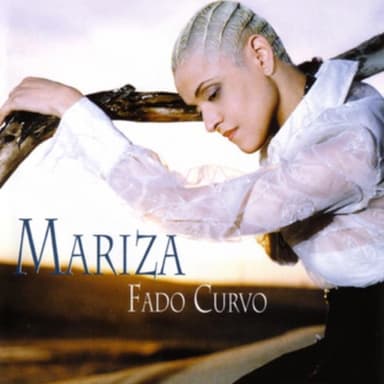
Fado Curvo
Mariza
Mariza arrived in the early 2000s as the definitive voice of fado's living present, and "Fado Curvo" (Curved Fado) demonstrates why her claim to that position is musical rather than merely commercial or political. The word "curvo" — curved, bent, arched — describes something about the song's emotional architecture: the way grief does not fall straight down but curves, circles back, arrives from unexpected angles. Her voice is extraordinary by any standard — a mezzo that can ascend into soprano territory, a vibrato she controls with absolute precision, a timbral range from near-whisper to full projection without losing quality or centering. She is Lisbon-born of mixed Mozambican and Portuguese heritage, and her fado reflects that intersection: warmer than the traditional pale-skinned Portuguese tradition in its physical presence, with a stage charisma that is distinctly contemporary, yet rooted deeply enough in the harmonic and melodic traditions that the oldest fado listeners recognize her as legitimate. The production on her recordings is modern — cleaner, more spacious than the early fado recordings, benefiting from recording technology that serves rather than overwhelms. "Fado Curvo" builds through repetitions of its central melodic phrase, each iteration finding a new emotional angle on the same structural material, which is exactly what "curvo" suggests: approaching the same truth from a different direction, knowing it can never be approached directly. A recording for understanding why fado survived the twentieth century intact and entered the twenty-first still capable of discovery.
medium
2000s
luminous, building, circular
Portugal
Fado. Fado contemporâneo.
melancholic, searching. Cycles through its central melodic phrase with each repetition approaching grief from a different emotional angle, building accumulative depth without arriving at resolution..
energy 5. medium. danceability 2. valence 4.
vocals: powerful mezzo, precise vibrato, wide range, controlled, contemporary.
production: Portuguese guitar, modern production, clean, spacious.
texture: luminous, building, circular. acousticness 7.
era: 2000s. Portugal.
A recording for understanding why fado survived the twentieth century and entered the twenty-first still capable of discovery.