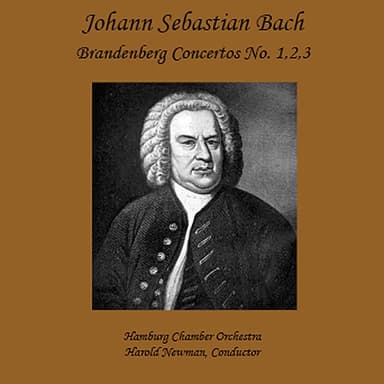
Brandenburg Concerto No. 3
Johann Sebastian Bach
Three violins, three violas, and three cellos enter simultaneously in Brandenburg Concerto No. 3, and from the first bar it is clear that Bach has no interest in a solo instrument's primacy — everyone is equal, everyone is active, and the result is a conversational polyphony so dense it seems to generate its own forward motion without needing a conductor's dramatic intervention. The first movement proceeds at a relentless gallop, each instrumental voice weaving through the others in a continuous interlocking pattern that rewards close attention but also functions perfectly as energetic background texture. The famous second movement is barely a movement at all — two chords, the musical equivalent of a knowing glance between musicians — before the third movement erupts with the same driving energy as the first. The Baroque ensemble sound is bracingly clean compared to Romantic orchestration, the lack of vibrato giving everything an almost architectural precision. Written around 1721 for the Margrave of Brandenburg, it is among the most purely enjoyable pieces in Western music, a demonstration that intellectual rigour and physical pleasure need not be separated. It is perfect for early-morning focused work, the complexity present but never intrusive.
fast
1720s
dense, clean, interlocking
German
Classical, Baroque. Baroque concerto.
energetic, intellectual. Sustains relentless forward momentum throughout, with a single two-chord pause before erupting back into the same driving energy.
energy 7. fast. danceability 5. valence 8.
vocals: instrumental.
production: chamber strings, polyphonic, no vibrato, Baroque ensemble, architecturally precise.
texture: dense, clean, interlocking. acousticness 10.
era: 1720s. German.
Early-morning focused work when complexity is welcome but must not intrude.