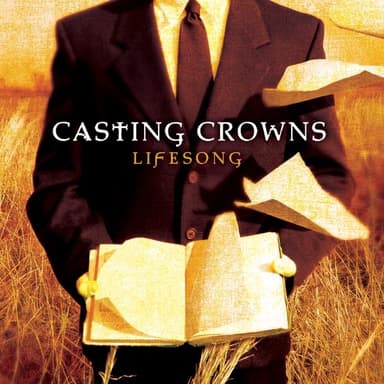
Lifesong
Casting Crowns
Lifesong is the kind of Casting Crowns track that made the band the defining voice of mid-2000s thoughtful contemporary Christian music — not because it is technically innovative, but because the lyric identifies a specific form of spiritual dissonance and names it with unusual precision. The production is mid-tempo rock, guitars understated and warm, the rhythm section giving the song forward momentum without overwhelming the vocal. Mark Hall's voice is earnest and plainspoken, the delivery of someone who leads a church small group rather than a recording session, and that quality — the sense of someone thinking out loud rather than performing — is what distinguishes Casting Crowns from more polished CCM contemporaries. The lyric asks a question that is genuinely uncomfortable: does the life being lived outside church walls match the declarations made inside them? The "lifesong" metaphor posits that daily existence is itself a form of worship or its negation — that how someone treats colleagues, neighbors, and strangers is a more accurate theological statement than what is sung on Sunday morning. Released in 2005, it resonated broadly with listeners who recognized the gap between profession and practice without yet having language for the specific discomfort. It is a song best heard in private, when the dissonance it identifies is felt rather than abstract — music that functions as quiet examination rather than celebration.
medium
2000s
warm, grounded, clear
North American / Christian
Christian Pop, CCM. Contemporary Christian Rock.
Reflective, Sincere. Holds steady in quiet self-examination, building gently toward understated personal commitment.
energy 5. medium. danceability 4. valence 6.
vocals: earnest, plainspoken, conversational, sincere, understated.
production: understated guitars, warm rhythm section, restrained, mid-tempo rock, vocal-forward.
texture: warm, grounded, clear. acousticness 5.
era: 2000s. North American / Christian.
Private listening when the gap between stated belief and daily practice is felt rather than theoretical.