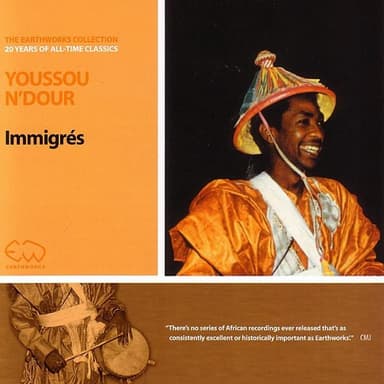
Immigrés
Youssou N'Dour
This is one of the documents of a world in transition. N'Dour made this album in 1984, and the title track addresses the experience of Senegalese workers who had traveled to France — drawn by economic necessity, by the labor vacuum left in Europe's postwar reconstruction, by the promise of wages that did not exist at home — and found themselves suspended between two worlds, belonging fully to neither. The mbalax rhythm section here is characteristically intricate, the sabar drums weaving dense polyrhythmic patterns that carry centuries of West African musical knowledge into the modern city, and N'Dour's vocal is impassioned without being sentimental — he is not mourning so much as bearing witness. The production has a raw, live quality that suits the subject: this is not polished protest music, it is the sound of a community trying to process its own displacement. The language shifts and the tonal textures remind you constantly that this music emerged from a specific place — Dakar, the Medina quarter, the griot tradition transformed by electric instruments and urban experience. To listen to it is to understand something about the 1980s African diaspora that no amount of historical reading quite delivers. Reach for it when you want music that takes its subject seriously without losing the physical pleasure of rhythm.
medium
1980s
raw, dense, rhythmic
Senegalese, Dakar Medina quarter, griot tradition transformed by urban diaspora experience
World Music, Afropop. Mbalax.
melancholic, defiant. Opens under the weight of displacement and sustains impassioned, earnest witness throughout without tipping into sentimentality..
energy 6. medium. danceability 6. valence 4.
vocals: passionate male tenor, griot-influenced, impassioned, Wolof delivery.
production: sabar drums, dense polyrhythmic percussion, electric instruments, raw live quality.
texture: raw, dense, rhythmic. acousticness 4.
era: 1980s. Senegalese, Dakar Medina quarter, griot tradition transformed by urban diaspora experience.
When you want music that takes the subject of displacement seriously without sacrificing the physical pleasure of rhythm.