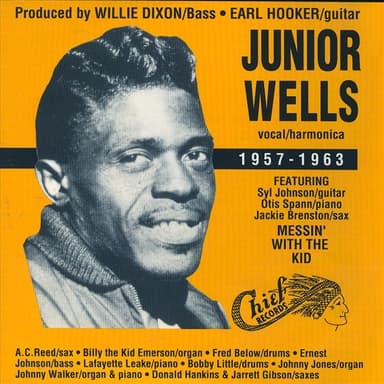
Messin' with the Kid
Junior Wells
Junior Wells comes in swinging with an energy that's half boast, half genuine irritation — a young man (or a man who refuses to stop being young about certain things) laying down a clear, non-negotiable warning. The guitar — Buddy Guy in his lean, stinging early form — cuts through in short, sharp phrases that punctuate Wells's vocal the way an exclamation point ends a threat. The harmonica runs fast and punchy rather than lyrical, more percussive than melodic in places, reinforcing the track's combative posture. The rhythm section locks into a hard-driving shuffle that doesn't ornament itself with anything extra — this is a working band playing for a working crowd. Wells's voice is younger-sounding than many of his contemporaries, with a brightness and an edge that's closer to irritation than pain. The song became an anthem partly because of its universality — anyone who has been underestimated, talked down to, handled wrong — recognizes the feeling it captures. It sits squarely in the mid-1960s Chicago blues-soul crossover moment, when the music was beginning to talk back more loudly to the culture around it. You play it when someone has tested your patience one time too many and you need something to validate the feeling before you respond.
fast
1960s
bright, sharp, driving
Chicago blues-soul, mid-1960s crossover moment
Blues, Soul. Chicago Blues-Soul crossover.
defiant, aggressive. Launches immediately into confrontational assertion and sustains that combative energy without softening toward the end..
energy 8. fast. danceability 7. valence 5.
vocals: bright, edgy, youthful male, punchy and confrontational.
production: stinging Buddy Guy guitar, fast punchy harmonica, hard-driving shuffle, working-band economy.
texture: bright, sharp, driving. acousticness 2.
era: 1960s. Chicago blues-soul, mid-1960s crossover moment.
When someone has tested your patience one time too many and you need something to validate the feeling before you respond.